
Palatine Epoxy Floors applies polyaspartic floor coating systems for homeowners and businesses in Palatine, IL, backed by more than 20 years of preparing and coating concrete, serving surrounding cities including Barrington, Lake Zurich, Prospect Heights, Deerfield, Wood Dale. Polyaspartic is the fast-curing, sunlight-stable topcoat behind many of today’s garage and commercial floors.
The chemistry earns its reputation, but no topcoat rescues a poorly prepared slab. Every polyaspartic floor we install starts with diamond grinding or shot blasting, crack repair and moisture testing, because the speed of the coating means nothing if the bond underneath fails in the first winter.
Our proposals name the exact products in each layer, the order they go down and the finished thickness. When a sales pitch elsewhere promises a one-coat, one-day floor, that written breakdown is the easiest way to compare what is actually being installed.
What Polyaspartic Coating Is and Why It Is Used
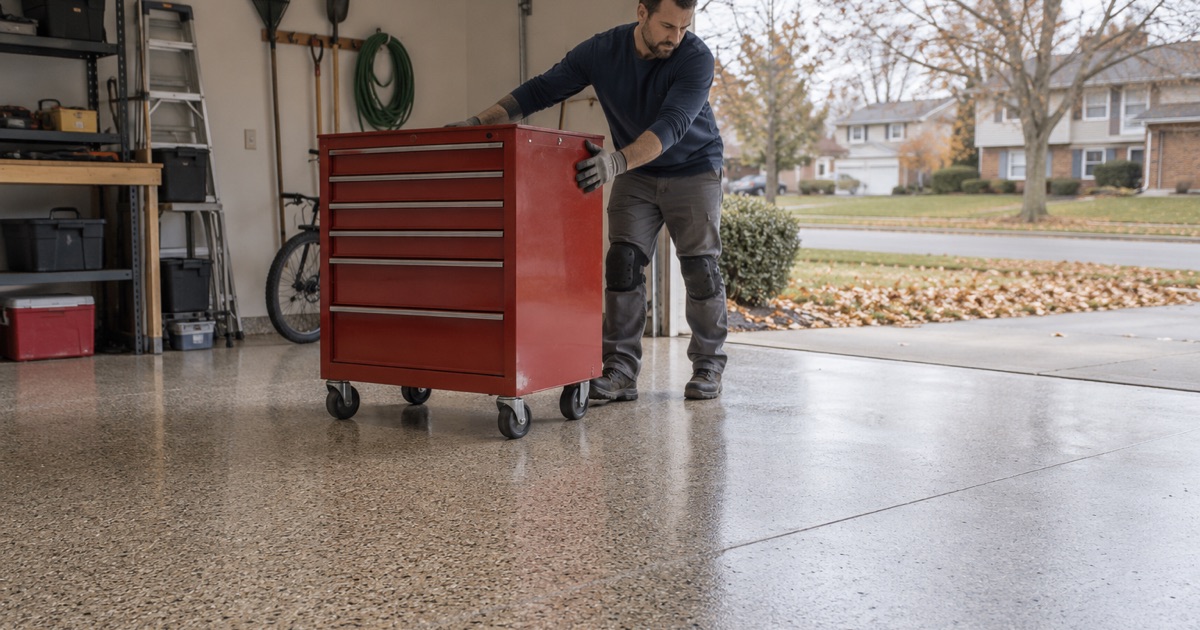
A Member of the Polyurea Family
Polyaspartic coatings belong to the aliphatic polyurea family, developed to keep the toughness of polyurea while giving installers a workable pot life. They cure through a chemical reaction rather than by drying, and they can build a hard, abrasion-resistant film in a fraction of the time an epoxy needs.
That speed is a strength and a challenge. A batch can begin to set while it is still being spread, so the crew has to mix in small quantities, work quickly and keep a wet edge. It is not a product that forgives hesitation, which is one reason kit versions are rare.
Color That Holds Under Sunlight
Aliphatic polyaspartics resist the ultraviolet breakdown that turns ordinary epoxy amber. On a garage floor where the door is open on summer afternoons, or a showroom behind a wall of glass, that color stability keeps a clear topcoat clear and a gray floor gray.
It is also why polyaspartic is the usual choice for a topcoat even when the base layers are epoxy. The base contributes body and bond, and the polyaspartic shields everything beneath it from light, abrasion and chemicals.
Abrasion and Chemical Resistance
Polyaspartic topcoats stand up well to tire scuffs, dragged equipment, oil, gasoline and the brine that northern Illinois winters bring in on every vehicle. The surface stays hard and glossy longer than most epoxy topcoats under the same traffic.
Chemical resistance still varies from product to product, so we match the topcoat to what actually lands on the floor. A home garage, an auto service bay and a commercial kitchen each get a different recommendation.
Polyaspartic Floors in Palatine Homes
Garage Floors That Return to Use Quickly
For homeowners, the appeal is usually time. A polyaspartic topcoat can let the garage return to foot traffic and then parking sooner than an all-epoxy system, which matters when the car has nowhere else to go.
We still give a return-to-service date based on the slab temperature and products measured on the day, not a generic promise. Parking on a topcoat before it has cured enough is one of the quickest ways to mark a new floor.
Flake Systems With a Polyaspartic Clear Coat
Our most common residential build pairs an epoxy base with a full vinyl flake broadcast and a polyaspartic clear coat over the top. The flake hides minor slab flaws and everyday dirt, and the clear coat locks the chips in and takes the wear.
The clear coat’s thickness and texture are adjustable. A heavier build and more grip near the entry steps suit a family garage, while a smoother finish suits a hobby space or a car collector’s floor.
Townhome Garages on a Tight Schedule
About 15 percent of Palatine’s homes are townhomes, and their garages often sit side by side under one association. A fast-curing topcoat helps when the board wants work finished quickly and neighbors need their own garages back.
We work from the association’s approval, follow its rules on hours and staging, and plan the cure window so nobody’s driveway access is blocked longer than necessary. Neighbors get the schedule in advance, so nobody is surprised by a closed garage.
Polyaspartic Floors for Commercial Spaces
Showrooms, Retail and Front-of-House
Showrooms, salons, retail floors and restaurant dining areas use polyaspartic for its gloss, color stability and quick turnaround. A space can often be coated after closing and reopened with far less downtime than an epoxy system would demand.
Decorative builds work here too. Flake, quartz and metallic layers can all sit under a polyaspartic clear coat, so a business can choose a look without giving up a durable, easily cleaned surface.
Auto Service Bays and Workshops
Service bays combine hot tires, jack stands, dropped tools and spilled fluids. A thick epoxy base under a chemical-resistant polyaspartic topcoat handles that combination well, and a textured finish keeps technicians steady on a floor that is rarely perfectly dry.
We detail trench drains, lift bases and the junction at the bay door carefully, since those are the places where water and fluids sit longest and where a weak edge begins to peel.
Kennels, Clinics and Washdown Areas
Animal care facilities, clinics and utility rooms need a seamless floor that tolerates frequent cleaning and disinfecting. Polyaspartic topcoats resist many common cleaners and do not absorb odors the way bare concrete can.
Where floors see hot water or steam washdown every day, we may recommend urethane cement instead, because it handles thermal shock better than most resin topcoats. We say so during the estimate rather than after a floor starts to soften.
Getting a Polyaspartic Floor to Last
Preparation the Topcoat Depends On
A polyaspartic topcoat bonds to what is beneath it, and the base bonds to the concrete. If the concrete was etched instead of ground, or the old paint was left in place, the whole system shares that weak link. We grind every slab to an open profile and remove existing coatings before a drop of resin is mixed.
Cracks are read before the quote. Stable cracks are filled and ground flush, but a crack that is still moving will telegraph through any coating, and we tell you that plainly instead of promising otherwise.
Moisture Testing Under a Fast Coating
Fast curing does nothing to stop moisture rising through a slab. Many Palatine garage slabs were poured without a vapor retarder, which the model code allows for garages, so we test using ASTM F1869 calcium chloride kits or ASTM F2170 relative humidity probes before selecting a primer.
When readings are high, a moisture-mitigation primer goes down first. It adds a step and cost, and it is the difference between a floor that holds and one that blisters by spring.
Cold Slabs, Dew Point and the Illinois Season
O’Hare’s 1991-2020 normals count 121.3 days a year at or below 32 degrees, and slab temperatures in an unheated garage lag behind the air. Polyaspartic tolerates cooler conditions than epoxy, but it still needs a slab safely above the dew point, or condensation will cloud and weaken the cure.
We measure the slab and the dew point spread at its surface before every install. When the readings are not right, we reschedule rather than coat a floor that will not cure properly.
Recoating a Worn Polyaspartic Floor
Even a well-built floor wears in its busiest lanes over the years, most often where tires turn and where salty slush sits each winter. Because the wear happens in the topcoat, the fix is usually a scuff sand, a thorough cleaning and a fresh polyaspartic clear coat rather than a new floor.
Recoating works only while the base layers are still bonded. If the floor has started lifting in sheets or blistering from below, the problem is bond or moisture, and another topcoat will not hold. We check adhesion in a few spots before quoting a recoat, and we tell you plainly when a floor has gone past that point and needs to come up.
The warranty conversation follows the same rule. Coating warranties nearly always exclude damage from moisture rising through the slab, so we read the exclusions aloud before the job is sold, with moisture named first.
- 20+ Years Coating Concrete
- Moisture Tested Before We Coat
- Free Written Estimates