
Palatine Epoxy Floors installs commercial kitchen flooring for restaurants, bakeries, cafeterias, breweries and food production spaces in Palatine, IL, with more than 20 years of resin floor experience, and we serve surrounding cities including Barrington, Lake Zurich, Prospect Heights, Deerfield, Wood Dale. Kitchen floors face hot water, steam, grease, dropped pans and constant cleaning, and they have to pass a health inspection while doing it.
The floors that last in kitchens are seamless, sloped to drains, coved at the walls and built from materials that tolerate heat and moisture. The ones that fail are usually thin epoxies chosen for price, or tile floors whose grout lines have opened and started holding water and bacteria beneath the surface.
Every kitchen job starts with mechanical preparation of the slab, never acid etching, and a look at drains, slopes and moisture. The proposal names the system for each zone, the coving height and the finished thickness, and it sets out a schedule built around your service hours.
Building to the Illinois Food Code
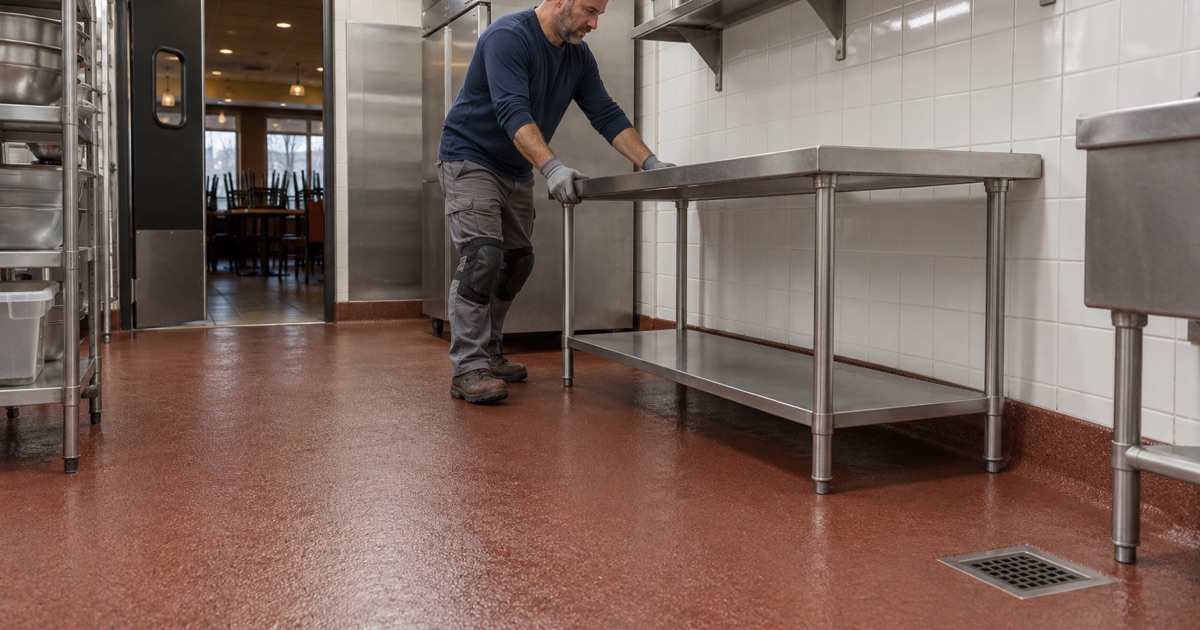
Smooth, Durable and Cleanable Floors
The Illinois Food Code follows the 2022 FDA Food Code, which requires indoor floor surfaces in food establishments to be smooth, durable and easily cleanable, and nonabsorbent where they are exposed to moisture. Seamless resin and urethane cement floors meet that standard directly, with no grout lines to absorb grease or break down.
Palatine runs its own food establishment inspection program, with environmental health practitioners who work from the Illinois Food Code. We build floors with those inspections in mind rather than leaving owners to discover gaps at the next visit.
Slip Resistance Where Floors Get Wet
A perfectly smooth floor in a wet kitchen is a hazard. Food Code section 6-201.11 resolves that by allowing anti-slip floor coverings in areas subject to moisture, flooding-type cleaning or spills. We broadcast graded aggregate into the system to create texture, then seal it so the floor stays cleanable.
The texture is tuned to each area. The cook line and dish room usually get more grip, while dry storage and front-of-house areas can be smoother and easier to mop.
Integral Coving at Floor and Wall Junctures
Food Code section 6-201.13 addresses coved and sealed junctures between floors and walls where floors are cleaned by water flushing. Integral coving carries the floor material up the wall in a continuous curve, eliminating the corner where water, food particles and bacteria collect.
We form coves in place from the same system as the floor, so there is no separate base to separate from the wall. Cove height is agreed with you and noted in the proposal.
Choosing Kitchen Floor Systems
Urethane Cement for Hot Washdown
Urethane cement is the workhorse of commercial kitchen flooring. It tolerates thermal shock from hot water and steam, cures in damp conditions and resists many food acids, fats and cleaning chemicals. It also handles some slab moisture better than standard epoxies.
We specify urethane cement on cook lines, dish rooms, walk-in entries and anywhere hot washdown happens. Where kitchens see heavy carts and dropped equipment, a thicker trowel-applied mortar adds impact resistance.
Epoxy for Dry Areas and Storage
Dry storage rooms, offices and some prep areas do not face the same heat and moisture, so a quartz-broadcast or flake epoxy system can be a cost-effective choice there. We match each area to its conditions rather than using one system for the whole building.
Transitions between systems are detailed carefully so there is no ridge or weak joint where carts roll from one zone to another. A smooth transition also removes a trip point for staff carrying hot pans.
Coolers and Freezers
Walk-in coolers and freezers expose floors to cold, condensation and frequent cleaning. Urethane cement systems rated for low temperatures are typically used inside walk-ins, and installation is planned for a time when the unit can be emptied and warmed.
The threshold between the walk-in and the kitchen is a common failure point, and we give it extra attention. Temperature swings and constant traffic meet at that line.
Drains, Slopes and Slab Conditions
Floor Drains and Trench Drains
Kitchen floors depend on drains working properly. We detail the floor around every floor drain, floor sink and trench drain so water flows in rather than pooling at the edge. Where slopes are poor, we can build up the floor to improve drainage before the finish system goes down.
Removing Quarry Tile and Old Floors
Many older kitchens have quarry tile with failing grout, cracked tiles and hollow spots. Water that gets under tile soaks into the slab, so we usually remove tile and setting beds, repair the slab and test moisture before installing a new seamless system.
Slab Moisture and Preparation
We diamond grind or shot blast the slab to the profile the system requires and repair cracks, joints and spalls. Moisture testing tells us whether a standard primer will work or whether the slab needs a moisture-tolerant system.
Scheduling Around Service
Phasing and Fast Return to Service
Restaurants cannot close for long. We phase work into sections, schedule around service hours and use fast-curing systems so kitchens can reopen quickly. Palatine bars construction work between 8:00 p.m. and 7:00 a.m., and loud Sunday work cannot start before noon, so work outside service hours is fitted into early mornings, closed days and the evening window before 8:00 p.m.
The proposal shows each phase, its cure time and the reopening time for every area. Where a kitchen can close for only one or two days, we sequence the work so the cook line returns first and storage areas follow.
Odor, VOC Limits and Occupied Buildings
Urethane and resin systems can produce odor while curing. We ventilate, contain work areas and choose products within the Illinois VOC limits for floor and industrial maintenance coatings, which bind the installer as well as the manufacturer. That matters in strip centers and mixed-use buildings where neighboring tenants stay open.
- 20+ Years Coating Concrete
- Moisture Tested Before We Coat
- Free Written Estimates