
Palatine Epoxy Floors installs ESD flooring for electronics assembly, laboratories, server rooms and other static-sensitive spaces in Palatine, IL, with more than 20 years of resin floor experience, and we serve surrounding cities including Barrington, Lake Zurich, Prospect Heights, Deerfield, Wood Dale. An ESD floor is a seamless resin system built to carry static charge safely to ground, so a technician walking across the room does not discharge into sensitive parts.
Static control floors are specified by numbers, not by appearance. The floor has to fall within a stated resistance range, work with the footwear people actually wear, and stay within range as it is cleaned and worn. That means the right conductive layers, proper grounding and testing of the finished floor before it goes into service.
Every ESD job starts with mechanical preparation of the slab, never acid etching, and moisture testing. The written proposal names each layer of the system, the grounding plan and the test method, so you can check the floor against your own ESD program.
How ESD Flooring Works
Conductive and Static-Dissipative Floors
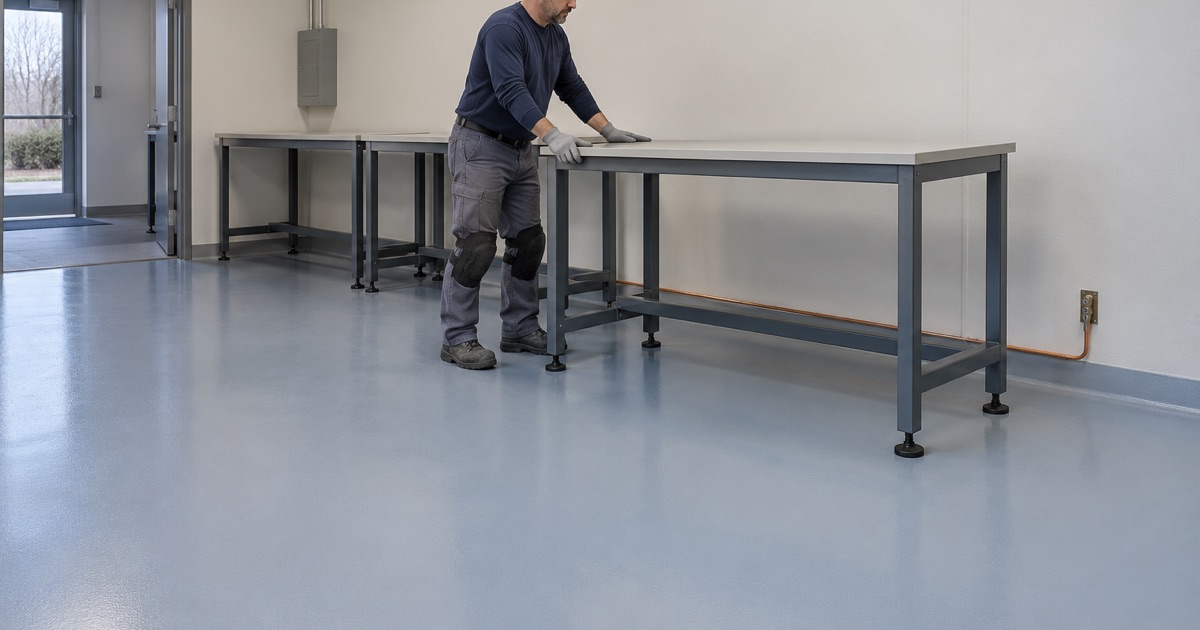
ESD floors fall into two classes. Under the ANSI/ESD STM7.1 test method, conductive floors measure at or below 1.0 x 10^6 ohms, while static-dissipative floors measure above that and drain charge more slowly. Many electronics areas use dissipative flooring, while some spaces handling especially sensitive parts call for conductive floors.
The choice is not ours to guess. Your facility’s ESD coordinator, the equipment maker or the customer requirements usually set the class, and we build the floor to that specification.
Floor and Footwear as One System
The ANSI/ESD S20.20 standard looks at the person, the footwear and the floor together. It asks for a person’s resistance to ground through footwear and flooring to stay below 1.0 x 10^9 ohms, and for the body voltage generated while walking to stay below 100 volts. A floor that tests well alone can still fail if paired with the wrong shoes.
We ask about the footwear or heel grounders your staff use before recommending a system, because the floor and the shoes have to work together. A mismatch shows up in testing, not in appearance.
Grounding Points and Conductive Layers
An ESD resin floor usually starts with a conductive primer or a grid of copper tape laid on the prepared slab, connected to building ground at set points. The ESD body coat and topcoat above contain conductive materials that carry charge down to that layer and out to ground.
The grounding connections are planned with the electrical layout of the room. Without them, even a conductive coating has nowhere to send the charge.
Where ESD Floors Are Used
Electronics Assembly and Repair
Circuit board assembly, electronics repair and component handling areas are the most common ESD floor applications. A discharge too small for a person to feel can still damage a component, and the floor is often the largest single surface in the static control program.
Palatine’s employer base includes electrical equipment manufacturers and engineering firms, and the wider northwest suburbs hold many light-industrial buildings where electronics work happens alongside other operations. We can isolate an ESD zone within a larger coated floor.
Server Rooms and Data Spaces
Server rooms, network closets and control rooms use static-dissipative floors to protect equipment that runs constantly. A seamless resin floor also sheds less dust than bare concrete, which helps keep air handling and equipment cleaner.
These rooms rarely go fully offline, so we plan the work around racks, cable trays and cooling equipment that stay in place. Sections can be coated in sequence while equipment is protected and the room stays operational.
Laboratories and Clean Spaces
Laboratories, testing rooms and some medical and research spaces need floors that combine static control with chemical resistance and easy cleaning. ESD resin floors can do both, with integral coving at walls so spills and cleaning water do not reach the joint between floor and wall.
Installing and Testing an ESD Floor
Slab Preparation and Moisture
An ESD floor depends on the same bond as any resin floor. We diamond grind or shot blast the slab, repair cracks and joints, and test moisture before the conductive primer goes down. High moisture readings call for a moisture-mitigation layer, which has to be compatible with the conductive system.
Old coatings are tested for adhesion. Well-bonded coatings can sometimes become the base for an ESD system, while failing ones must be removed.
Testing the Finished Floor
When the floor has cured, we test resistance across the surface with calibrated meters following the method your facility specifies, and record the readings by location. You receive those results for your quality and ESD program files.
If any area falls outside the specified range, we find the cause and correct it before the floor goes into service. We do not hand over an ESD floor on the assumption that it works.
Keeping the Floor in Range
Cleaning products matter. Waxes, polishes and residue-leaving cleaners insulate the surface and push resistance out of range, so we provide a maintenance plan with approved cleaners. Most facilities retest their floors on a schedule set by their own ESD program.
Wear in heavy traffic lanes can also change readings over time, and an ESD topcoat can be renewed in those areas when needed. Catching that drift early keeps the floor inside its specified range.
Scheduling and Compliance
Working Around Production
ESD areas are often in active production, so we phase installation around shutdowns, weekends or slow periods. Palatine bars construction work between 8:00 p.m. and 7:00 a.m., and loud Sunday work cannot start before noon, so schedules are built within those limits.
Each phase includes its cure time and testing before the area returns to use. The proposal sets out that sequence in advance, so production managers know exactly when each zone will be unavailable and when it will be ready.
Registration and VOC Limits
Illinois issues no state license for flooring or coatings, so we provide the village registration, bond and insurance each municipality requires. Every product we use is chosen within the Illinois VOC limits for floor and industrial maintenance coatings, which bind the installer as well as the manufacturer.
- 20+ Years Coating Concrete
- Moisture Tested Before We Coat
- Free Written Estimates