
Palatine Epoxy Floors provides concrete grinding and surface preparation for homes and businesses in Palatine, IL, built on more than 20 years of getting slabs ready for coatings, polish and new flooring, and we serve surrounding cities including Barrington, Lake Zurich, Prospect Heights, Deerfield, Wood Dale. Grinding is the step that decides whether anything placed on top of the concrete will hold.
Most coating failures we are called to fix trace back to preparation. Paint over sealer, epoxy over an acid etch, new coating over old coating: each leaves a weak layer between the concrete and the finish. Diamond grinding and shot blasting remove that layer and open the slab so primers can soak in and bond.
We never acid etch. Every slab is prepared mechanically, cracks and old coatings are read before we quote, and when a slab needs repair before it can take a finish, we say so plainly in the proposal.
Grinding and Shot Blasting Methods
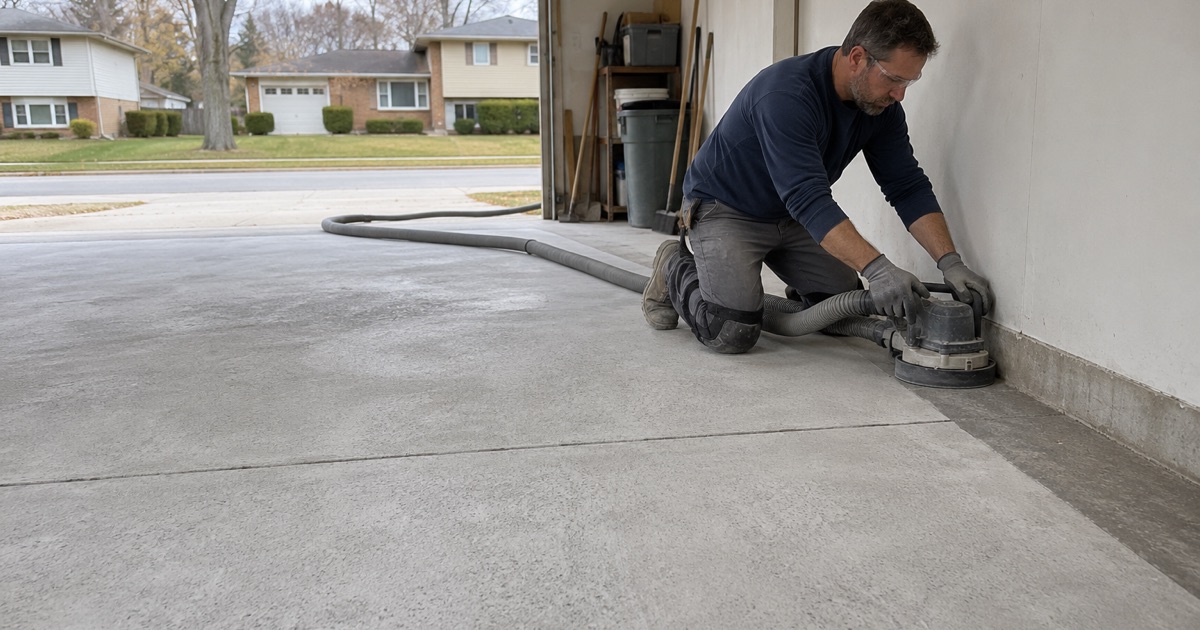
Diamond Grinding
Diamond grinders use rotating heads fitted with metal-bond or resin-bond diamond segments to cut the concrete surface. Coarser segments remove coatings and flatten high spots quickly, while finer segments refine the surface for polishing. Grinding works well in garages, basements and rooms with edges and corners, and edge grinders reach right up to the walls.
Grinding also lets us control how much concrete is removed. A light pass opens a sound slab for a thin coating, while repeated passes cut through old epoxy, sealers or oil-contaminated concrete.
Shot Blasting
Shot blasters propel small steel shot at the slab and recover it with a vacuum, leaving a uniformly textured surface. On large, open commercial floors, shot blasting covers ground quickly and produces an ideal profile for thicker coating systems.
It is less suited to tight rooms and edges, so many commercial jobs pair a shot blaster for the field with grinders along walls, columns and around equipment. The two methods leave compatible profiles when matched correctly.
Surface Profile and the ICRI Scale
The International Concrete Repair Institute publishes a scale of concrete surface profiles, numbered CSP 1 through CSP 10, from nearly smooth to deeply roughened. Each coating manufacturer specifies a profile range for its products, because thin films and thick mortar systems need very different textures to bond.
We grind or blast to the profile the specified product calls for and check the result against ICRI comparison chips, rather than guessing whether the floor is rough enough. Too smooth and the coating has little to grip; too rough and a thin coating cannot cover the peaks.
Removing Old Coatings and Adhesives
Paint, Sealers and Failed Epoxy
Old garage paints, clear sealers and failing kit epoxies must come off before a new system goes down. A new coating bonded to an old one is only as strong as that old bond, so leaving it in place builds failure into the new floor from day one.
We test how well an existing coating holds during the estimate, then grind it off completely where it is failing or where the new system calls for bare concrete. Removal is listed as its own line in the proposal.
Carpet Glue, Tile Mastic and Thinset
Basements and commercial spaces often have layers of carpet adhesive, vinyl tile mastic or thinset mortar left from previous floors. These gummy or hard residues clog ordinary tooling, so we use aggressive segments designed to remove them without smearing them deeper into the slab.
Some older black mastic adhesives can contain asbestos. When a floor’s age and appearance suggest that possibility, a sample should be tested before grinding begins, and we will not grind a suspect adhesive until the result is known.
Oil and Contaminated Concrete
Garage and shop slabs often have oil, grease or chemical stains soaked into the surface. Grinding removes much of the contaminated layer, and degreasing treats what remains. Deeply soaked areas may need repeated grinding before a coating will bond reliably.
Oil that has wicked deep into a slab can keep weeping back to the surface for weeks after cleaning. Where we see that, we tell you before quoting a coating, and we may recommend a treatment and a waiting period rather than coating over a stain that will push the new floor off.
Leveling, Patching and Repairs
Removing High Spots and Lippage
Older slabs often have uneven joints, ridges from previous repairs or high spots from original finishing. Grinding brings those down so the floor is flatter for a coating, polish, tile or plank flooring. This matters especially for metallic epoxy and large-format tile, which show every bump.
Grinding has limits, though. Removing too much concrete exposes coarse aggregate and can weaken a thin slab, so we take high spots down only as far as the finished floor needs and fill the low areas rather than grinding the whole slab to the lowest point.
Filling Cracks, Pits and Holes
After grinding opens the surface, cracks, pits, popouts and anchor holes are easier to see. We fill them with repair materials that grind smoothly and bond well with the coating system. Stable cracks disappear under a coating, while moving cracks are discussed honestly before the job, because a coating follows the slab beneath it.
Most of Palatine’s homes were built between 1960 and 1989, so many basement and garage slabs carry decades of patches, removed fixtures and old repairs that need attention at this stage.
Dust Control and Working Conditions
HEPA Vacuums and Containment
Concrete dust contains crystalline silica, which should not be breathed. Our grinders run with HEPA-filtered vacuums attached directly to the grinding heads, capturing dust where it is created. In occupied homes and businesses, work areas are sealed off and the floor is vacuumed thoroughly before coating.
Dust left on the slab is just as harmful to the finished floor as it is to the air. A film of fine powder under a primer acts like a release agent, so the final vacuuming pass is part of the bond, not housekeeping.
Moisture Testing After Grinding
Grinding exposes the concrete, which makes it a good time to test moisture before choosing a primer. Palatine garage slabs may have no vapor retarder beneath them, and basements here sit in soils with a seasonal water table in spring, so the test result decides whether a moisture-mitigation primer is needed.
Working Hours and Noise
Grinding is loud. Palatine bars construction work between 8:00 p.m. and 7:00 a.m., and on Sundays loud work cannot begin before noon, so we schedule grinding within those hours and coordinate with neighbors or building managers where noise travels.
- 20+ Years Coating Concrete
- Moisture Tested Before We Coat
- Free Written Estimates