
Palatine Epoxy Floors grinds and finishes polished concrete floors for homes and businesses in Palatine, IL, drawing on more than 20 years of concrete floor work, and we serve surrounding cities including Barrington, Lake Zurich, Prospect Heights, Deerfield, Wood Dale. Polished concrete turns the slab you already have into the finished floor, with no coating on top to peel, chip or lift.
The process is mechanical from start to finish. Diamond tooling grinds the surface flat, a lithium silicate densifier hardens it, and progressively finer diamonds bring it to the sheen you choose. What you end up with is concrete that reflects light, sheds dust and cleans with a mop.
Polishing reveals the slab rather than hiding it, so we look at the concrete closely before quoting. Old patches, adhesive stains and cracks will show, and we tell you plainly when a slab would be better served by a coating than by polish.
How Polished Concrete Floors Are Made
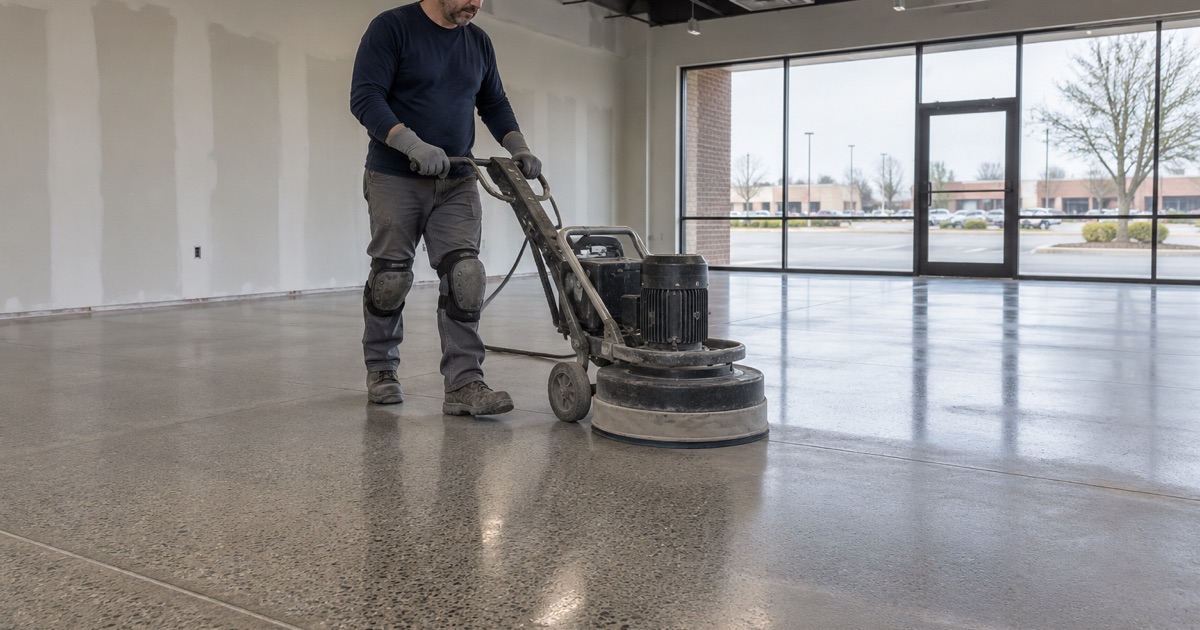
Metal-Bond Grinding and Aggregate Exposure
The first passes use metal-bond diamonds that cut away the surface paste and flatten the slab. How deep those passes go decides how the floor reads: a light grind leaves a cream finish with little stone showing, a moderate grind reveals fine sand and small aggregate, and a deeper grind exposes the larger stone throughout.
The choice depends on the slab as much as on taste. A floor with uneven finishing may need a deeper grind just to get flat, which exposes more aggregate whether you wanted it or not. We grind a sample area when a client has a specific look in mind.
Lithium Silicate Densifier
After the coarse grinding, a lithium silicate densifier goes into the open concrete. It reacts with the free lime in the slab to form a harder surface that resists dusting and abrasion, which is what lets the concrete take and hold a polish.
Densifying at the right stage matters. Applied too early, much of it is ground away. Applied too late, the surface has closed and it cannot penetrate. We densify between the metal-bond and resin-bond stages so it soaks deep into the paste.
Resin-Bond Polishing and Sheen Level
Resin-bond diamonds refine the surface through a sequence of finer grits. Each pass removes the scratches left by the one before, and where we stop sets the sheen, from a low satin glow to a reflective high gloss.
Higher gloss looks dramatic in a showroom but shows wear sooner in a busy entry. For most homes and offices, a mid-level sheen balances clarity with practicality. A penetrating guard can be added at the end to help resist stains from oils and drinks.
Dyes and Color for Polished Concrete
Polished concrete does not have to stay gray. Penetrating dyes can be applied between polishing passes to tint the slab in warm browns, deep charcoals or brighter accent colors, and saw-cut lines can separate one color field from another or frame a border around a room.
Dye soaks into the concrete rather than sitting on top, so it wears with the floor instead of flaking. The color is never perfectly uniform, because each slab absorbs differently, and that variation is part of the appeal. We test dye on a sample area so you see how your concrete takes it before the whole floor is colored.
Residential Polished Concrete Floors
Basements Without a Film to Peel
Polished concrete suits many basement slabs because there is no coating for rising moisture to push off. Water vapor that would blister an epoxy simply passes through the polished surface, which makes polish a sensible option where a slab tests a little high but is otherwise sound.
Palatine’s poorly drained till soils carry a seasonal water table that rises in late winter and spring, so we still read the slab carefully. Active efflorescence will keep reappearing, and a slab that takes on water through cracks needs those fixed before it can be finished well.
Living Spaces, Lower Levels and Additions
In finished lower levels, home offices and additions, polished concrete gives a clean, modern floor that works with radiant heat and area rugs. It does not trap allergens the way carpet can, and it holds up to pets, furniture and kids without scratching through a finish.
Existing slabs in older homes often carry tack strip holes, glue residue and patch work from earlier flooring. We grind those out where possible, but some marks remain part of the floor’s character, and we show you how they will look before you commit.
Why We Rarely Polish a Garage
A polished garage floor looks striking at first, but winter brine and road salt are hard on bare concrete even after densifying. Salt residue etches the surface, oil drips soak in, and hot tires leave marks a coating would have shrugged off.
For most Palatine garages we recommend a full-thickness coating instead. We would rather steer you to the floor that lasts than sell the one that looks best on the day it is finished.
Commercial Polished Concrete Floors
Retail, Offices and Showrooms
Retail floors, office lobbies and showrooms choose polished concrete because it is durable, bright and inexpensive to maintain over time. A polished slab reflects light and can make a space feel larger and cleaner, and it takes foot traffic, rolling carts and display moves without a coating to scuff.
Palatine’s commercial redevelopment is clustered along Rand Road, Dundee Road and Northwest Highway, where many buildings occupy older slabs that have carried tile, carpet or vinyl. Grinding off old adhesive and polishing the slab is often a practical alternative to installing another floor covering.
Warehouses, Schools and Light Industry
Large open floors in warehouses, schools and light-industrial buildings benefit from polishing because it removes dusting and requires no recoat cycle. Forklifts and pallet jacks run on the concrete itself, and worn lanes can be repolished in place rather than stripped and recoated.
Joints matter in these buildings. We fill control joints with a semi-rigid filler where wheeled traffic crosses them, so edges do not chip, and we coordinate grinding around racking and fixed equipment. Where a building needs aisle lines or safety zones marked, striping can be laid over the polished surface without coating the whole floor.
Working Around an Open Building
Commercial polishing is loud and produces dust, even with vacuum-attached grinders. We phase the work into sections, schedule around business hours, and keep each zone contained so offices, stores and schools can keep operating while the floor is finished.
Palatine bars construction work between 8:00 p.m. and 7:00 a.m., and on Sundays loud work cannot start before noon, so after-hours phasing is planned within those limits rather than around them.
Our Step-by-Step Polished Concrete Floors Process
Step 1: Slab Assessment and Test Area
We check flatness, cracks, patches, old adhesive and moisture, and grind a small test area where the final look is uncertain. The proposal names the aggregate exposure, sheen level and any repairs.
Step 2: Coarse Grinding and Repairs
Metal-bond diamonds flatten the slab and remove coatings and adhesives. Cracks and joints are filled, and holes are patched with a material that grinds and polishes with the surrounding concrete.
Step 3: Densifying
The lithium silicate densifier is applied to the open surface and allowed to react, hardening the concrete before the fine polishing begins. Any excess is removed before it can dry on the surface and leave a residue.
Step 4: Polishing and Protection
Resin-bond diamonds take the floor through finer grits to the agreed sheen, and a penetrating guard is applied where stain resistance matters. We finish with a written maintenance plan for your floor.
- 20+ Years Coating Concrete
- Moisture Tested Before We Coat
- Free Written Estimates