Palatine Epoxy Floors installs flake epoxy floor systems for garages, basements, workshops and commercial spaces in Palatine, IL, with more than 20 years of coating concrete behind every job, and we serve surrounding cities including Barrington, Lake Zurich, Prospect Heights, Deerfield, Wood Dale. A flake floor broadcasts colored vinyl chips into a wet epoxy base and seals them under a clear topcoat, creating a textured, speckled surface that hides wear well.
The flake is what people notice, but it is not what makes the floor last. That comes from the grinding beneath it, the base coat bonding into open concrete, and a topcoat applied at a thickness we state in writing. A flake floor laid over a poorly prepared slab looks just as good on day one and starts peeling in the tire tracks within a few seasons.
We grind every slab, read the cracks and test moisture before we quote, and the proposal names each product, the broadcast type and the finished thickness of the system. That way two quotes can be compared on what actually goes down.
How a Flake Epoxy Floor Is Built
Ground Concrete and a Bonded Base Coat
Every flake floor starts with diamond grinding to open the concrete and remove old paint, sealers and the weak surface layer. Acid etching cannot do that job; it leaves the surface weak and adds residue. Once the slab is ground, cracks are filled and dust is vacuumed away completely so the base coat bonds directly to sound concrete.
The base coat is a 100% solids epoxy, often tinted to blend with the flake. It provides the bond to the slab and the wet surface the chips sink into, so it has to go down at the right thickness and stay open long enough for a full broadcast.
Broadcasting the Vinyl Flake
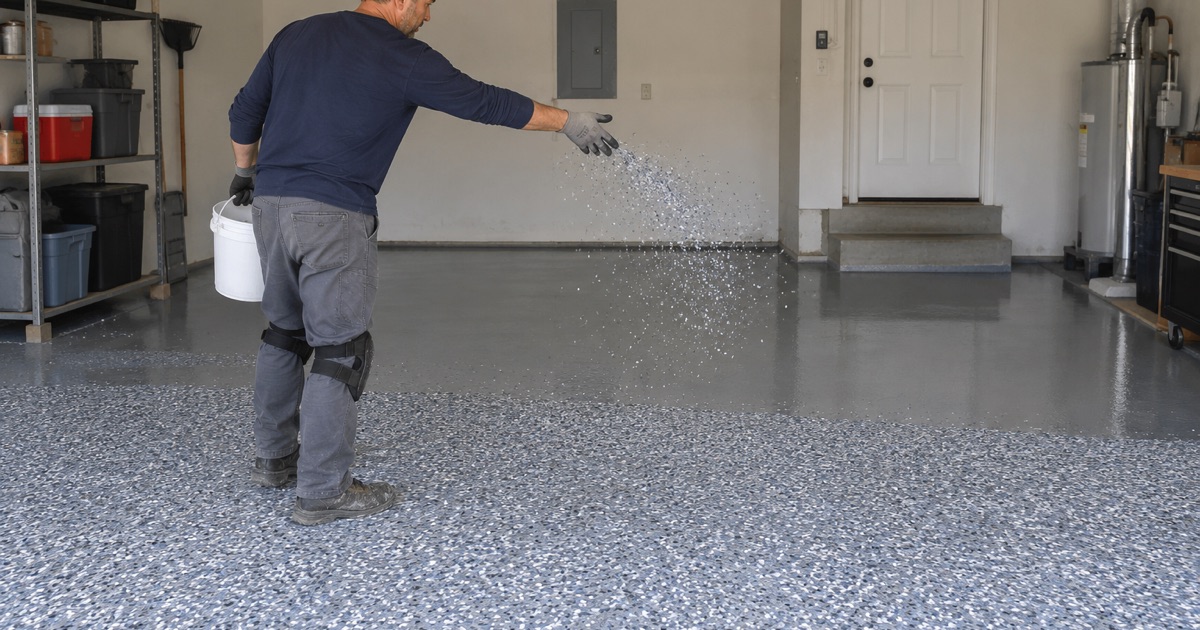
While the base is wet, flake is thrown by hand across the floor in a steady, even spread. For a full broadcast, we keep going until the surface is covered and no wet resin shows through. After the base cures, loose chips are scraped and vacuumed, leaving a dense, uniform layer locked into the epoxy.
Partial broadcast systems scatter less flake over a solid color for a lighter look. They use less material but hide less, and they show dirt and slab imperfections more readily than a full broadcast.
The Clear Topcoat
The clear topcoat seals the flake, sets the final texture and takes the daily wear. On most floors we use a polyaspartic topcoat, which resists abrasion, chemicals and hot tires and does not amber in sunlight. A thicker topcoat produces a smoother finish, while a thinner one leaves more of the flake’s texture for grip.
Where floors are often wet, fine aggregate can be added to the topcoat for extra slip resistance, especially near entry steps and garage doors. The aggregate is nearly invisible once sealed, so it changes how the floor feels underfoot far more than how it looks.
Choosing Flake Colors and Blends
Blends That Hide Dirt and Salt
Flake comes in hundreds of blends, from grays and tans to bold mixes with bright accents. For garages, blends with mid-tone grays, browns and a bit of white hide dust, tire marks and dried salt residue best. Very dark or very light blends show more.
We bring physical samples to the estimate so you can see blends on your own floor, in your own light. Garage lighting and daylight through the door both change how a blend reads.
Chip Size and Coverage
Larger chips create a bolder, more textured look and hide slab imperfections well. Smaller chips produce a finer, more uniform surface that some homeowners prefer for basements and living spaces. Mixed sizes give a more natural, stone-like appearance.
Chip size also affects the topcoat. Larger chips usually need a heavier clear coat to fully encapsulate their edges, which adds to the system thickness and is reflected in the proposal.
Flake Floors in Garages and Basements
Garage Floors Through Illinois Winters
Flake floors are popular in Palatine garages because they handle the calcium chloride brine and rock salt that winter tracks in on tires. The topcoat keeps brine on the surface where it can be squeegeed out, and the flake hides the dried residue between cleanings.
Many garage slabs here were poured without a vapor retarder, which the model code allows for garages, so we test moisture before every garage install. In an unheated garage, we also check slab temperature and dew point, and when deep winter conditions are wrong, we schedule for spring rather than coat a cold slab.
Basements, Laundry Rooms and Workshops
In basements, a flake floor gives a warmer, finished look than bare concrete and stands up to laundry spills, playroom traffic and workshop use. Palatine’s poorly drained till soils hold a seasonal water table through late winter and spring, so basements get a moisture test and, when needed, a moisture-mitigation primer.
Floor drains and sump pits are detailed carefully so water still reaches them and lids remain removable. Those openings are where basement coatings most often fail, so they get the same attention as the open floor.
Flake Floors for Commercial Spaces
Shops, Showrooms and Locker Rooms
Flake systems work well in auto shops, showrooms, locker rooms, break rooms and retail backrooms. The texture adds grip, the colors hide wear and the seamless surface cleans quickly. For heavy traffic, we increase the base and topcoat thickness and choose chemical-resistant topcoats.
Commercial flake floors are phased around business hours, and Palatine bars construction work between 8:00 p.m. and 7:00 a.m., so we plan installation days within those limits. Each area’s reopening time is written into the proposal.
Flake Compared With Quartz Broadcast
Quartz broadcast is the commercial cousin of flake, using colored sand-sized aggregate instead of vinyl chips. It builds a harder, more slip-resistant surface suited to commercial kitchens and wet areas. Flake gives more color variety and a smoother feel underfoot, so we recommend whichever suits the room’s traffic and cleaning.
- 20+ Years Coating Concrete
- Moisture Tested Before We Coat
- Free Written Estimates