Palatine Epoxy Floors installs metallic epoxy floor systems in homes and businesses throughout Palatine, IL, building on more than 20 years of concrete coating work, and we serve surrounding cities including Barrington, Lake Zurich, Prospect Heights, Deerfield, Wood Dale. A metallic floor is the most decorative system we install, with pearlescent pigments that swirl into a marbled, three-dimensional finish no other floor can copy.
That finish is also the least forgiving. Every ridge, patch, roller mark and speck of dust left under the metallic layer shows through the moving pigment, and the coat itself has to be worked by hand while it is still flowing. The preparation underneath has to be close to flawless before the decorative work even begins.
We start every metallic job by grinding the slab, filling every crack and hole, testing for moisture and building a smooth base coat. The written proposal names each layer, its product and the finished thickness, so you know exactly what sits beneath the finish you will be looking at for years.
How a Metallic Epoxy Floor Is Built
Grinding and Filling for a Flawless Base
Metallic epoxy magnifies whatever is underneath it. We diamond grind the slab to an open profile, remove old paint and sealers, and fill cracks, pits, saw cuts and spalls with repair material that is ground flush. A rough patch that would vanish under a flake broadcast stands out clearly under a metallic layer.
We also look closely at the cracks before quoting. A stable crack can be filled and hidden, but a crack that is still moving will eventually show through any coating, and a crack line across a metallic floor is impossible to miss. We point those out before the job is sold.
The Base Coat That Sets the Stage
Once the slab is prepared, a tinted 100% solids epoxy base coat goes down. It seals the concrete, provides a uniform background color and creates the smooth surface the metallic layer flows across. The base color matters, because it shows through lighter areas of the metallic and changes how the final pattern reads.
The base must cure to the right point before the metallic layer is poured. Too soft and the pigment sinks into it, too hard without sanding and the next layer may not bond well. We time it by the slab temperature and the dew point, not by the clock.
Pouring and Working the Metallic Layer
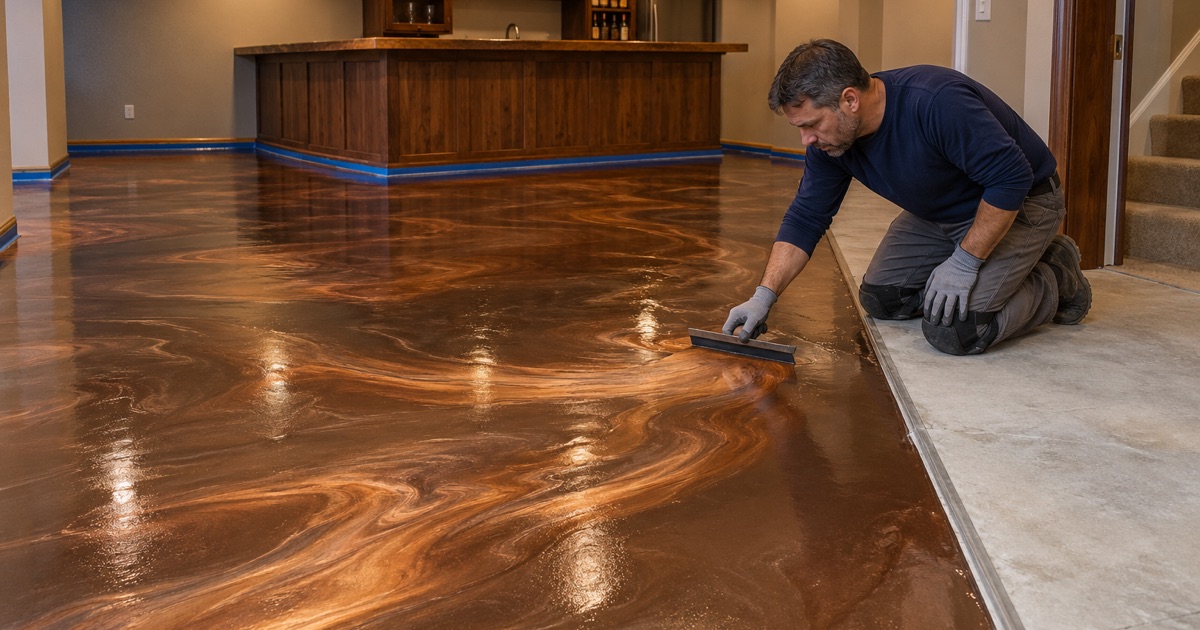
The metallic coat is a clear epoxy loaded with pearlescent pigment, poured in ribbons and spread across the base. While it flows, the installer works it with rollers, trowels, brushes, sprayers and sometimes solvent mists to steer the pigment into veins, swirls, ripples or broad clouds of color.
This is the stage that separates an experienced crew from an inexperienced one. The working time is short, every area has to blend into the next without a seam, and decisions are made in seconds. Dust, insects and drafts have to be kept away while the layer levels.
Clear Topcoat and Texture
The metallic layer is beautiful but soft compared to a dedicated topcoat. We seal it under a clear polyaspartic or aliphatic urethane topcoat chosen for the room’s traffic, chemicals and sunlight exposure, at a thickness stated in the proposal.
Where the floor will get wet, fine clear aggregate is mixed into the topcoat for grip. It barely changes the look, but it makes a real difference to footing in a garage, a basement bar or a showroom entry on a snowy day.
Metallic Floors in Palatine Homes
Basement Bars, Media Rooms and Lounges
Finished basements are the most popular place for a metallic floor in a home. A deep blue, copper or charcoal metallic can turn a lower-level bar, theater or game room into the most striking space in the house, and the seamless surface handles spilled drinks and moved furniture well.
Basement slabs come with moisture questions, though. Palatine’s till soils hold a seasonal water table through late winter and spring, so we test every basement slab and use a moisture-mitigation primer where readings call for it, because a blister in a metallic floor is as visible as a crack.
Garages for Car Owners and Collectors
A metallic garage floor suits a car collector’s space or a showpiece hobby garage, where the floor is part of the display. It needs a heavy-duty topcoat to stand up to hot tires, jack stands and the calcium chloride brine every winter brings in on the wheels.
We are honest about the tradeoff. A metallic finish shows scratches and salt residue more readily than a full flake floor, so for a daily-use family garage we often recommend flake and save metallic for the space where appearance is the priority.
Kitchens, Mudrooms and Living Areas
Metallic epoxy can also go down over slabs in kitchens, mudrooms, sunrooms and lower-level living areas, giving a seamless, easy-to-clean floor without grout lines. In areas with daylight, a UV-stable topcoat is essential to keep pale metallics from ambering.
The floor feels like the slab beneath it, cool and firm, so many homeowners pair it with area rugs. We leave the edges ready for baseboards and trim so the finished room looks complete.
Metallic Floors for Businesses
Showrooms, Salons and Retail Spaces
Businesses choose metallic floors when the floor itself is part of the brand. Showrooms, salons, boutiques and restaurants can match brand colors and create a surface customers remember. The seamless finish also cleans quickly and resists the scuffs of steady foot traffic.
Palatine’s commercial corridors along Rand Road, Dundee Road and Northwest Highway include plenty of storefronts on older slabs. Grinding out old tile adhesive and pouring a metallic system can transform a dated space without the joints and edges of a new floor covering.
Offices, Lobbies and Studios
Office lobbies, creative studios and fitness spaces use metallic floors to make an impression without adding maintenance. A well-sealed metallic needs only regular dust mopping and a neutral cleaner to stay bright.
We can add saw-cut lines, borders or inlaid logos to divide areas or highlight an entrance. Those details are laid out before the metallic layer goes down and then sealed under the same topcoat.
Scheduling Around Business Hours
Commercial metallic floors are typically installed after hours or during planned closures, since each layer needs time to cure undisturbed. We plan the schedule around when the space can be empty and keep dust contained to the work area.
Palatine bars construction work between 8:00 p.m. and 7:00 a.m., and loud work on Sundays cannot start before noon, so our phasing works within those hours. The proposal lays out each layer’s day and the reopening date.
Getting the Metallic Floor You Want
Choosing Colors and Movement
Most metallic floors combine a base color with one to three metallic tones. Contrasting colors produce dramatic veining, while tones close to each other create a subtle, cloudy depth. We show physical samples and discuss the movement style, whether bold swirls, soft ripples or a stone-like look, before work begins.
Lighting changes the effect. A metallic that looks muted under warm basement lights can glow under bright showroom fixtures, so we view samples in the actual room whenever possible.
Illinois VOC Limits and Product Choice
Illinois limits the VOC content of floor and industrial maintenance coatings under 35 Ill. Adm. Code Part 223, and that limit binds the person applying the coating as well as the manufacturer. Every resin, pigment carrier and topcoat we use is chosen within those limits.
That matters particularly in an occupied home or business, where lower-solvent products also mean less odor during the cure. We ventilate the space and keep doors to living areas closed during installation.
- 20+ Years Coating Concrete
- Moisture Tested Before We Coat
- Free Written Estimates